The Complete Guide to Modern Google Search Ads for Growing SMEs (2026 Edition)
Google Ads has changed.
Not just in features or interface, but in how decisions are made, how bids are set, how ads are matched to intent, and how performance is actually driven. What used to be a largely manual, keyword-and-bid driven platform is now an AI-powered auction system, making millions of real-time decisions every second based on signals most businesses never even see.
For growing SMEs, this shift can feel unsettling.
You might be spending more, seeing less clarity, and wondering why “doing the right things” doesn’t always translate into predictable results. You may hear about automation, Smart Bidding, broad match, Performance Max, and machine learning but without a clear mental model of how it all fits together, it’s hard to feel in control.
This guide is designed to change that.
Not by overwhelming you with jargon, but by calmly walking through how modern Google Search actually works today; how the auction operates, how Google’s AI makes decisions, what levers still sit firmly in your hands, and how all of this can be structured into a system that supports sustainable growth.
Whether you are yet to get started, manage your own campaigns, work with an agency, or are considering bringing in senior strategic support, the aim is simple:
To help you feel informed, confident, and equipped to make better decisions about your paid search investment.
A Practical Guide to Google Search Ads (For Those New to the Platform)
What Are Google Search Ads?
At their simplest, Google Search Ads are a way of showing your business to people at the exact moment they are looking for something you offer.
When someone types a query into Google; for example, “loft conversion company near me” or “IT support for small business” the results page shows two types of listings:
Organic results, which are ranked by SEO
Paid search ads, which appear at the top and bottom of the page and are labelled as ads
Google Search Ads allow you to appear in those paid positions.
You only pay when someone clicks on your ad, which is why the model is known as pay-per-click (PPC).
Why Search Ads Are So Powerful
The real strength of Google Search Ads isn’t the format.
It’s the intent behind the search.
Unlike social media or display advertising, where you interrupt people while they’re browsing, Search Ads connect you with people who are actively looking for:
A solution
A supplier
Advice
A product or service
In other words, you’re meeting demand that already exists, rather than trying to create it.
This is why Search is often one of the most commercially efficient digital channels for SMEs. You’re not guessing who might be interested. You’re responding to a clear signal of need.
Where Search Ads Fit in a Growth Strategy
For growing businesses, Google Search Ads often play three roles:
Demand Capture
Showing up when people are already looking for what you do.Market Insight
Learning how customers describe their problems, what language they use, and what matters most to them.Scalable Growth
Once the foundations are right, Search can be increased or decreased in a controlled way, in line with capacity and commercial goals.
This is why Search Ads are so often the starting point for performance marketing. They provide clarity, immediacy, and a direct link between spend and intent.
How to Set Up Google Search Ads
Setting up Google Search Ads isn’t just a technical exercise. It’s about putting the right foundations in place so the system can learn, optimise, and support your business goals over time.
A calm, structured setup at the start saves a great deal of confusion later.
1. Creating Your Google Ads Account
The first step is simply creating an account and connecting it to:
Your website
Your billing details
Your conversion tracking (which we’ll cover shortly)
At this stage, it’s less about building lots of campaigns and more about ensuring the account is:
Correctly named and structured
Linked to Google Analytics (if you use it)
Set up with the right time zone and currency
Owned by the right people, with proper access controls
This creates a stable home for everything that follows.
2. Campaign Goals
Before you choose keywords or write ads, it’s worth pausing to define what success looks like.
Common goals include:
Generating enquiries or leads
Driving online sales
Increasing calls or bookings
Building awareness in a new market
Google will ask you to select a campaign goal, but the more important question is the business one:
“What action, if someone took it, would genuinely move us forward?”
This decision guides:
How you bid
What you track as a conversion
How you measure return
How the system learns what to prioritise
Clear goals give the platform clarity. And clarity leads to better performance.
3. Choose Your Demographic
Search Ads are driven primarily by keywords and intent, but you can still apply useful layers of focus, such as:
Geographic targeting (countries, regions, towns, radius around a location)
Language
Device preferences
Audience signals (for example, previous site visitors or in-market segments)
These settings don’t restrict the system so much as guide it, helping your ads appear in the contexts that matter most to your business.
4. Create Your Budget
Budgets in Google Ads are set as an average daily amount.
This means:
Some days you may spend slightly more
Some days slightly less
Over the course of the month, Google aims to average out to your daily figure multiplied by the number of days
The important thing to remember is that your budget is not a commitment to spend at all costs. It is a control mechanism:
You decide what you’re comfortable investing
The system works within that boundary
You can adjust it as confidence and performance grow
A good starting budget is one that allows enough data for learning, without putting pressure on short-term results. The aim early on is to gather insight and build a stable performance baseline, not to force immediate scale.
Creating Campaigns & Ads
This is where strategy begins to take shape.
A well-structured campaign makes everything that follows easier: bidding, optimisation, reporting, and scaling. A rushed or messy structure, on the other hand, often leads to confusion, wasted spend, and a sense that the platform is “out of control”.
The aim is simple:
Group similar intent together, and speak to it clearly.
Conduct Keyword Research
Keywords are how you tell Google what types of searches you want to appear for.
Good keyword research starts with understanding:
What your customers are trying to achieve
The language they use to describe their problem
How close each search is to taking action
This usually includes a mix of:
High-intent commercial terms (“IT support company London”)
Service-specific queries (“office network installation”)
Problem-led searches (“computer keeps crashing at work”)
Brand and competitor terms
The goal isn’t to build a huge list. It’s to build a relevant, well-prioritised one that reflects real demand.
Negative Keyword List
Just as important as where you do show, is where you don’t.
Negative keywords allow you to exclude searches that:
Are irrelevant
Indicate research rather than buying
Relate to jobs, training, or unrelated industries
Don’t match what you offer
This keeps your spend focused and helps the system learn what “good intent” really looks like.
Think of negatives as guardrails. They don’t restrict growth; they guide it.
Keep Your Ad Groups Organised
Each ad group should represent a clear theme or intent, for example:
One service
One product category
One problem type
One location cluster
Within each group:
Keywords share similar meaning
Ads speak directly to that intent
Landing pages closely match the promise of the ad
This alignment improves:
Relevance
Click-through rate
Quality Score
Conversion performance
And, just as importantly, it makes your account easier to understand and manage.
Writing Your Search Ads
Modern Google Search uses Responsive Search Ads, which allow you to provide multiple headlines and descriptions. Google then tests combinations to find what resonates most in different situations.
When writing your assets, it helps to include:
Clear statements of what you do
The problems you solve
Key benefits and differentiators
Trust signals (experience, location, accreditations, reviews)
A simple call to action
Rather than trying to write the “perfect” single ad, you’re creating a library of messages that the system can assemble in the most relevant way for each search.
Return on Investment
Once your campaigns are live, the focus naturally shifts from setup to performance. The question becomes less about “Are the ads running?” and more about “Are they delivering value for the business?”
This is where a calm, structured approach really pays off.
Adjust Bids
Bids determine how competitively you enter each auction.
Today, most accounts benefit from Smart Bidding, where Google adjusts bids automatically in real time based on the likelihood of conversion or value. Your role then becomes one of guidance rather than micromanagement:
Setting realistic targets
Giving the system time to learn
Providing accurate conversion and value data
Adjusting goals when business priorities change
When changes are needed, they’re made with intention, not as a reaction to a single day’s performance.
Testing & Changes
Improvement in Google Ads is rarely about one big switch. It’s usually the result of steady, thoughtful refinement.
This can include testing:
Different ad messages
Alternative landing pages
New keyword themes
New audience signals
Adjusted bidding targets or budgets
The key is to test one or two things at a time, measure their impact, and allow enough time for learning. This avoids the sense of constantly “chasing” the account and instead builds a rhythm of calm optimisation.
Key Metrics
A few core metrics help you read performance clearly and make informed decisions.
-
The percentage of people who click and then take the action you care about. It reflects how well your ads and landing pages align with intent.
-
Google’s measure of relevance and experience, based on expected click-through rate, ad relevance, and landing page quality. Strong Quality Score supports better positions at lower cost.
-
What you pay, on average, for each visit. Useful for understanding competitiveness and efficiency, but always best viewed alongside conversion rate and value.
-
The revenue generated for every pound spent on ads. Particularly important for e-commerce and value-based bidding, and a helpful way of keeping investment aligned with profitability.
Keywords & Match Types
Keywords are how you tell Google what kinds of searches you want to be visible for. They act as signals of intent, helping the platform understand when your ads should be considered for an auction.
But in modern Search, keywords are no longer just literal words. They are starting points for meaning.
Google now looks beyond exact phrasing and interprets:
The intent behind the query
The context of the search
The behaviour of similar users
The likelihood that this search could lead to a valuable outcome
This is where match types come in.
Broad Match
Broad match gives Google the most freedom to interpret meaning and explore relevant demand. It can match your keywords to searches that are related in intent, even if the wording is quite different.
Used well (and paired with Smart Bidding and good negatives), broad match helps you:
Discover new high-value search terms
Capture long-tail demand you wouldn’t think to add manually
Allow the system to learn which intent patterns drive results
Think of it as controlled exploration, not uncontrolled expansion.
Example:
google ads consultant
Broad match could show your ad for searches like:
“help running google ads for small business”
“ppc expert for growing company”
“marketing agency to manage paid search”
“someone to fix underperforming google ads”
“freelance digital marketing lead”
These aren’t the same words, but the intent is aligned:
“I need expert help with Google Ads.”
Phrase Match
Phrase match offers a balance between reach and structure.
It allows variation in wording, but keeps the core meaning of your keyword intact. This is useful when:
You want to expand beyond exact wording
You still want strong thematic control
You’re building clearly defined intent groups
Example:
"google ads management"
Phrase match could show for:
“outsourced google ads management uk”
“affordable google ads management services”
“b2b google ads management”
The core meaning remains, but Google can flex around:
Location
Business size
Industry
Cost intent
This is ideal for service pages where:
The intent is clearly commercial
You want reach, but not conceptual drift
Exact Match
Exact match is your precision layer.
It focuses on searches with the same or very close intent to your keyword and is often used for:
Brand terms
Core service searches
High-intent, bottom-of-funnel queries
Exact match provides stability and efficiency, anchoring performance while broader layers explore and learn.
Example:
[fractional marketing director]
Exact match might show for:
“fractional marketing director”
“fractional marketing director uk”
“fractional marketing director for saas”
But not for:
“marketing jobs director”
“what is a marketing director”
“interim marketing salary”
This protects:
Your highest-value positioning
Your brand language
Bottom-of-funnel searches
Common Myths & Mistakes
When businesses first start with Google Search Ads, a few misconceptions often create unnecessary worry or frustration. Addressing them early helps set expectations and builds confidence.
-
In reality, the auction is based on Ad Rank, not just bid. Relevance, expected click-through rate, landing page experience, and the usefulness of your ad all play a role. Strong structure and quality can often outperform bigger budgets.
-
Broad match without structure can be inefficient. Broad match with Smart Bidding, good conversion data, and clear negatives becomes a powerful way to scale into new, relevant demand.
It’s not about looseness. It’s about guided learning.
-
Automation changes where control sits, not whether you have it.
Instead of adjusting individual bids, you control:
The goals the system optimises towards
The conversions and values it learns from
The structure of your campaigns
The boundaries through budgets and negatives
This is higher-level, more strategic control.
-
Smart Bidding and modern matching rely on learning. Performance usually improves over time as patterns become clearer. Early volatility doesn’t mean failure; it often means the system is still understanding your audience.
Patience and consistency are part of good optimisation.
-
Search is not a one-off project. Markets change, competitors move, and customer behaviour evolves. Ongoing review, testing, and refinement are what turn a working account into a strong, dependable growth channel.
How the Google Ads Auction Actually Works
Before we talk about match types, Smart Bidding, or AI, it’s important to understand the foundation everything sits on: the auction.
Every time someone searches on Google, an auction takes place in a fraction of a second. But it’s not a simple case of “whoever bids the most wins”. Google’s system is designed to prioritise usefulness, relevance, and experience; not just budget.
Understanding this is quietly powerful. It means smaller, well-run accounts can compete with much larger ones, and that strategic structure often matters more than raw spend.
What Is Ad Rank (And Why Bid Alone Doesn’t Win)
At the heart of the auction is something called Ad Rank. This is the score Google uses to decide:
Whether your ad is eligible to show
Where it appears on the page
How much you actually pay for a click
Your maximum bid is only one part of that equation.
The Components of Ad Rank
Ad Rank is calculated using a combination of:
Bid – the most you’re willing to pay for a click
Expected Click-Through Rate – how likely your ad is to be clicked
Ad Relevance – how closely your ad matches the user’s intent
Landing Page Experience – how useful and trustworthy the page is
Impact of Assets – sitelinks, callouts, and other enhancements that improve usefulness
What this means in practice is reassuring: you’re not in a pure spending war. You’re in a relevance and experience competition.
How Quality Beats Budget
A well-structured account with:
Clear intent alignment
Thoughtful messaging
Fast, relevant landing pages
Strong historical engagement
can often outrank a higher-bidding competitor who hasn’t built that foundation.
This is where strategic setup pays dividends over time, and where Google Ads becomes less about “chasing clicks” and more about building a system that consistently earns attention.

Google Ads auction infographic explaining Ad Rank, Quality Score, and how higher relevance and user experience can beat higher bids, comparing a large budget advertiser with a smaller, smarter advertiser.
Second-Price Auction Explained Simply
Another common misconception is that you always pay your full bid. In reality, you usually pay just enough to beat the advertiser below you.
So if your bid is £5 and the next highest effective Ad Rank equates to £2.50, you might pay £2.51 for that click; not £5.
This creates space for efficiency, not just scale.
Quality Score, Explained in Human Terms
Google summarises the health of your relevance and experience through Quality Score, which is made up of three core elements:
Expected Click-Through Rate
How compelling and relevant your ad is likely to be compared to others.
Ad Relevance
How closely your ad copy aligns with the meaning and intent of the search.
Landing Page Experience
How helpful, clear, and trustworthy your page feels once someone clicks.
Seen together, these are not technical hurdles; they are simply a structured way of asking:
“Are we giving the searcher what they are actually looking for, in a way that feels easy and reassuring?”
Why This Matters for Growing Businesses
Understanding the auction properly changes how you think about optimisation.
Instead of only asking:
“Should we raise bids?”
You start asking:
Are we matching the right intent?
Is our message genuinely helpful?
Does our landing page build confidence?
Are we giving the system the right signals to learn from?
This is where control returns. Not through micromanaging every penny, but through designing a system that earns visibility through relevance and trust.
Match Types in 2026: Broad, Phrase, Exact
For a long time, keywords felt like the main control lever in Google Ads.
Choose the right words, match them carefully, and you could tightly dictate when your ads appeared.
That world has shifted.
Today, Google matches on meaning and intent, not just the literal words typed into the search box. This change can feel uncomfortable at first, especially if you’ve been used to precise, manual control. But when understood and guided properly, it actually creates more opportunity, not less.
The key is knowing what each match type now does, and how to use them together in a structured, safe way.
Matching on Meaning, Not Words
When someone searches, Google is no longer simply looking for exact strings of text. It is interpreting:
What the person is trying to achieve
The context of their query
Their location, device, and language
How similar users have behaved in the past
Your keywords act as signals, not strict filters.
Semantic Intent Matching
Semantic matching means Google looks at the concept behind a search, not just the phrasing.
So a keyword like:
“car window repair”
can now be eligible to show for searches such as:
“replace broken car glass”
“automobile window replacement”
“fix smashed side window”
The words differ, but the intent is the same. Google’s systems are designed to recognise that shared meaning.
Close Variants & Reordered Queries
Even with tighter match types, Google allows:
Plurals and singulars
Misspellings
Reordered word structures
Function words added or removed
This is not “looseness” for its own sake. It’s an attempt to avoid missing genuinely relevant searches simply because a person phrased something slightly differently.
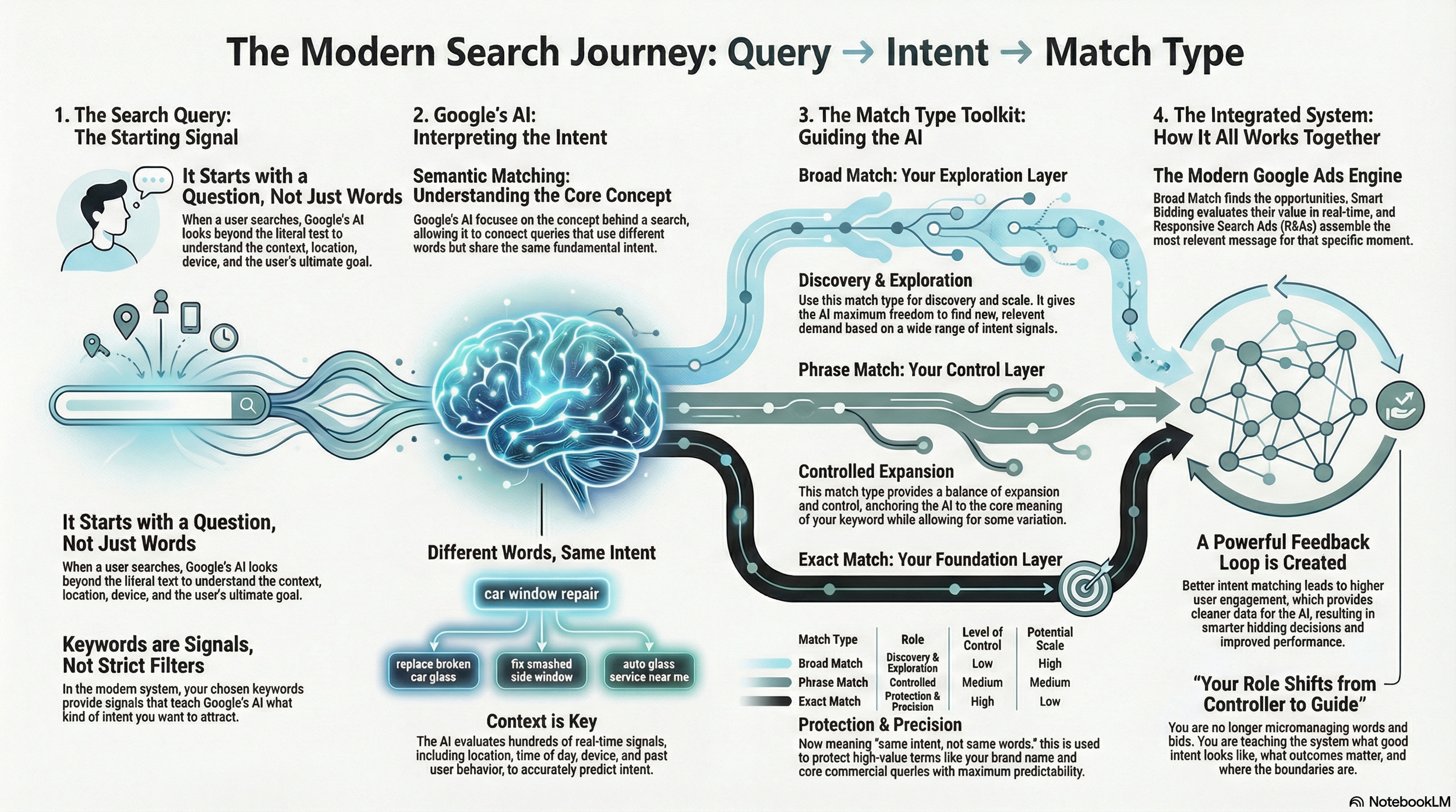
Diagram explaining how Google Ads matches search queries to intent using AI and keyword match types, showing the role of broad match, phrase match, and exact match in guiding relevance and scale.
When to Use Each Match Type
The three match types still exist, but their roles have evolved.
Broad for Discovery & Scale
Broad match is designed to help you discover new, relevant demand.
It uses:
Search intent
Contextual signals
Historical performance
Audience behaviour
Location, device, and language
When paired with Smart Bidding, it doesn’t simply chase volume. It learns which types of searches are most likely to convert or drive value, and focuses investment there.
Think of broad matches as your exploration layer.
Phrase for Control with Expansion
Phrase match sits in the middle.
It allows variation and expansion, but still anchors around the core meaning of your keyword. It’s useful when:
You want reach beyond exact wording
You still want tighter thematic control
You are building out structured intent clusters
Exact for Brand & High-Intent Protection
Exact match now means “same intent”, not “same words”.
It is still invaluable for:
Brand terms
High-intent bottom-of-funnel searches
Core commercial queries where efficiency matters most
Think of exact match as your foundation layer; stable, predictable, and reliable.
Guardrails – How You Scale Without Losing Control
Expansion only feels risky when it’s unguided.
The role of structure is to give Google’s systems freedom to learn, while still protecting your budget and your brand.
Negative Keywords as Strategic Filters
Negative keywords are no longer just housekeeping. They are how you:
Block irrelevant intent
Shape the learning space for Smart Bidding
Prevent your budget being diluted by curiosity-driven searches
They act like boundaries around the field you’re inviting Google’s AI to explore.
Search Term Insight and Pattern Recognition
Rather than reacting to individual queries, mature accounts look for:
Repeating intent themes
Consistent low-quality patterns
New profitable categories emerging
This is where strategic oversight replaces micromanagement.
Bringing It Back to Confidence
Match types today are less about rigid control and more about guided intelligence.
You are no longer telling Google exactly which words to match.
You are teaching it:
What good intent looks like
What outcomes matter
Where to explore
Where not to go
With the right structure, this becomes a collaboration rather than a risk.
Smart Bidding: How Google AI Sets Bids in Real Time
Once match types determine which searches you can appear for, bidding determines how competitively you show up in each of those moments.
This is where the biggest shift has happened.
In the past, bidding was largely manual. You set a number, applied a few adjustments, and hoped it broadly reflected the value of a click. Today, Google sets bids at the level of the individual auction, using far more information than any human could process in real time.
Understanding how this works removes a lot of the anxiety around “automation taking over”, and replaces it with something more useful: a clear sense of what the system is optimising for, and how you guide it.
Auction-Time Signals
Every time a search occurs, Google evaluates hundreds of signals before deciding:
Whether your ad is eligible to appear
How much it should bid for that specific impression
How likely that user is to convert or generate value
Location, Device, Time, Language, Intent
These include, among many others:
Location and proximity
Device and operating system
Time of day and day of week
Language and search context
Previous interaction behaviour
The specific wording and intent of the query
The type of conversion you value most
The important point is this:
Smart Bidding is not setting one average bid. It is setting a different bid for every single auction, based on how valuable that moment is predicted to be.
Core Smart Bidding Strategies
Each strategy simply answers a different business question.
-
“How can we get as many conversions as possible within our budget?”
Best when:
You’re building volume
You’re in a growth phase
You want the system to learn quickly
-
“How can we get conversions at a consistent cost?”
Best when:
You have a clear acceptable cost per lead or sale
You want predictability and efficiency
-
“How can we generate the most total revenue or value?”
Best when:
Not all conversions are equal
You care about quality and revenue, not just quantity
-
“How can we achieve a specific return on ad spend?”
Best when:
You have strong revenue tracking
You want profit-aligned optimisation rather than volume
Why Manual Bidding Now Limits Growth
Manual bidding can still work in very simple, low-volume environments. But as soon as scale, complexity, or multiple intent layers are involved, it struggles for one simple reason:
Humans can’t react to auction-time context.
We can’t:
Adjust bids for every device, location, time, and query combination
Model conversion probability in millisecondsLearn from millions of micro-patterns across accounts and industries
Smart Bidding can.
Automation with Oversight, Not Abdication
This doesn’t mean “set and forget”. It means shifting your role from:
“Adjusting numbers”
to:
Defining the right conversion actions
Assigning the right values
Structuring campaigns clearly
Feeding clean, reliable data
Setting realistic targets
Interpreting performance with commercial context
The system does the heavy lifting.
Strategy provides the direction.
The Reassuring Truth About Control
When Smart Bidding is set up properly, you are not losing control. You are moving it to a higher level:
From micromanaging bids, to governing outcomes.
You’re telling Google:
What success looks like
How much it’s worth
How aggressively to pursue it
Where the boundaries are
And then allowing it to execute with speed and scale.
Why Broad Match, Smart Bidding and RSAs Work Together
Individually, each of these elements is powerful.
Together, they form the core of how modern Google Search is designed to operate.
Rather than thinking in terms of keywords, bids, and ads as separate levers, it’s more helpful to see them as parts of one connected system:
Broad Match helps Google understand who to show ads to
Smart Bidding decides how much to bid in each moment
Responsive Search Ads determine which message to show
When aligned, they allow the platform to match the right person, with the right intent, to the right message, at the right price.
Google’s AI Search Stack
At a high level, the system works like this:
Broad Match explores and interprets intent
Smart Bidding evaluates the value of each opportunity
Responsive Search Ads assemble the most relevant message
All of this happens in real time, for every single search.
Broad Match = Query Discovery
Broad match gives Google the freedom to look beyond exact wording and understand what people are really trying to achieve.
It helps you:
Reach searches you wouldn’t think to add manually
Capture long-tail and emerging demand
Expand into new, but still relevant, intent categories
Learn what your audience actually cares about, not just how they phrase it
Importantly, when paired with Smart Bidding, broad match doesn’t simply chase volume. It learns which types of searches are likely to lead to outcomes you value, and gradually focuses spend there.
Smart Bidding = Price Optimisation
Smart Bidding then decides how much each of those moments is worth.
It looks at:
The specific query
The user’s context
Their likelihood to convert or generate value
Your chosen goal (CPA, ROAS, volume, revenue)
And adjusts bids in real time to prioritise the most promising opportunities.
This means you’re not paying the same price for every click. You’re paying more when the likelihood of success is higher, and less when it’s lower.
RSAs = Message Optimisation
Finally, Responsive Search Ads ensure that the message shown aligns with both:
The user’s intent
The context of the auction
By testing and combining different headlines and descriptions, Google can:
Emphasise the most relevant benefits
Reflect the language the user is searching with
Adapt messaging by device, location, and query type
Improve expected click-through rate and relevance over time
This is not about surrendering creative control. It’s about giving the system enough high-quality building blocks to assemble the most helpful message for each individual situation.
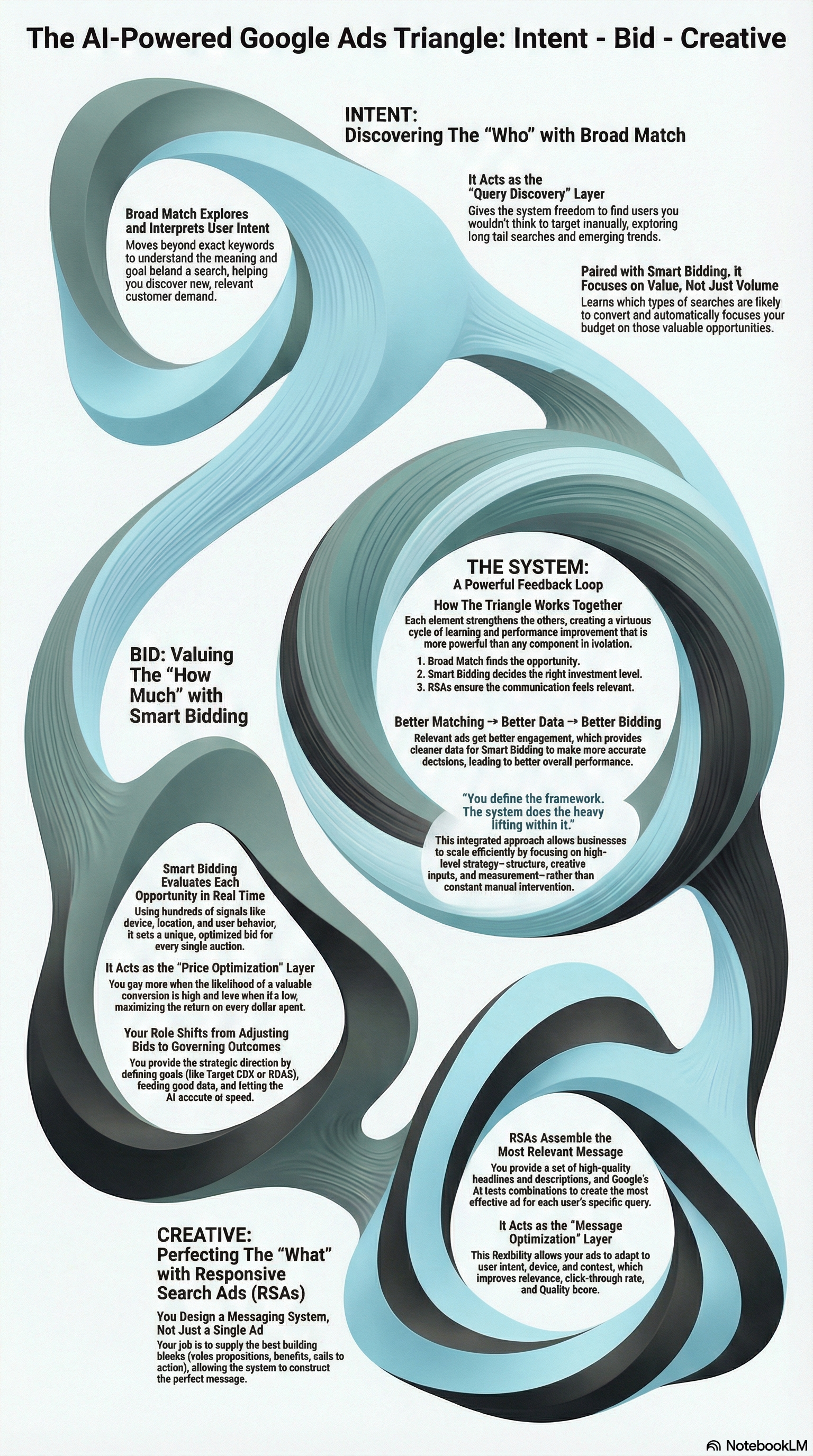
Why the System Works Better Together Than in Isolation
When these three elements are aligned, something important happens:
Broad Match finds the opportunity
Smart Bidding decides the investment level
RSAs ensure the communication feels relevant and timely
This creates a feedback loop:
Better matching → better engagement → better data → better bidding decisions → better performance.
Trying to use one without the others often creates friction.
For example:
Broad match without Smart Bidding can feel inefficient.
Smart Bidding without flexible creative can struggle with relevance.
RSAs without sufficient intent coverage can limit learning.
Together, they allow Google’s AI to operate as intended, while you retain strategic control through structure, measurement, and boundaries.
What This Means for Growing Businesses
For SMEs, this integrated approach offers something valuable: the ability to scale without relying on constant manual intervention.
Instead of chasing every new keyword, adjusting every bid, and testing every ad variation by hand, you focus on:
Clear campaign structure
Strong intent groupings
High-quality creative inputs
Accurate conversion and value tracking
Thoughtful use of negatives and exclusions
You define the framework.
The system does the heavy lifting within it.
Responsive Search Ads: Creative as a System
Creative in Google Search used to be relatively static. You would write a small number of ads, test them against each other, and gradually replace the weaker performers.
Today, creative works differently.
Responsive Search Ads (RSAs) turn your messaging into a flexible set of building blocks that Google can assemble in real time, based on the user, the query, and the context of the auction. This shift allows relevance to be optimised at scale, rather than through slow, manual testing cycles.
Understanding how this works helps you feel comfortable giving the system flexibility, while still maintaining clarity and control.
How RSAs Assemble Ads
Instead of one fixed headline and description, RSAs are made up of:
Multiple headlines
Multiple descriptions
Optional pinned elements for essential messaging
Google then tests different combinations and learns which arrangements perform best in different situations.
Asset Combinations Explained
Each time your ad is eligible to show, Google predicts which combination of headlines and descriptions is most likely to:
Match the user’s intent
Attract attention
Encourage a click
Support conversion behaviour
Over time, it learns which messages work best for different query themes, devices, and audiences.
Pinning vs Automation
Pinning allows you to fix certain elements in specific positions, for example:
A compliance statement
Your brand name
A mandatory legal phrase
This can be helpful when something must always appear. But overuse of pinning limits the system’s ability to learn and adapt.
A balanced approach is to:
Pin only what is essential
Let the rest of the creative rotate and learn
Review performance at the asset level rather than just the ad level
Ad Strength vs Real Performance
Google provides an “Ad Strength” score as a guide to how well your RSA is set up from a best-practice perspective.
It’s useful as a diagnostic, but it’s not a performance guarantee. The real indicators remain:
Relevance to intent
Expected click-through rate
Conversion performance
Alignment with your commercial message
Think of Ad Strength as a setup checklist, not a success metric.
Why RSAs Improve Relevance at Scale
RSAs allow Google to:
Reflect the language users are actually searching with
Emphasise different benefits for different intent types
Adapt messaging by device, location, and time
Continuously refine which value propositions resonate most
This leads to:
Higher expected CTR
Better Quality Score
Stronger Ad Rank
More efficient auctions over time
All without you needing to manually create and rotate dozens of individual ads.
Creative as a System, Not a Slogan
The shift with RSAs is subtle but important.
You’re no longer writing “the perfect ad”.
You’re designing a messaging system:
Core value propositions
Supporting benefits
Proof points
Trust signals
Calls to action
Each one becomes an asset that can be combined in different ways, allowing relevance to emerge through learning rather than guesswork.
Value-Based Bidding: Optimising for Revenue
As your marketing matures, a natural question emerges:
“Are we optimising for activity, or for impact?”
It’s one thing to generate traffic or even leads. It’s another to consistently drive the types of enquiries, sales, or opportunities that move the business forward in a meaningful way.
Value-based bidding is designed to make that distinction.
Rather than treating every conversion as equal, it allows Google to prioritise the outcomes that matter most to your commercial goals.
From Leads to Business Value
For many SMEs, not all leads are the same.
Some enquiries become long-term clients.
Some become one-off projects.
Some never progress beyond an initial conversation.
Optimising purely for “more conversions” can therefore increase activity without necessarily improving revenue or profitability.
Value-based bidding shifts the focus to:
Conversion quality
Revenue contribution
Lifetime value potential
Strategic importance of different actions
Assigning Conversion Values
This can be done in different ways, depending on your model:
Actual transaction revenue (for e-commerce)
Estimated lead value by service type
Weighted values by funnel stage
Offline conversion imports from CRM or sales systems
The goal isn’t perfection. It’s directionally correct data that allows the system to distinguish between “useful” and “exceptional”.
When tROAS Beats tCPA
Where Target CPA asks:
“How much can we afford to pay for a conversion?”
Target ROAS asks:
“What return should we generate for every pound we invest?”
This reframing helps align media investment with commercial reality, not just marketing metrics.
How Google Uses Value Signals
Once values are in place, Smart Bidding:
Predicts the likely value of each auction
Bids more aggressively when higher-value outcomes are likely
Bids more cautiously when lower-value outcomes are expected
Allocates budget towards the combinations of query, user, and context that historically produce stronger returns
Over time, this leads to a portfolio effect:
Not every click is maximised. The overall return is.
A More Grown-Up Way to Scale
Value-based bidding supports a calmer, more strategic approach to growth.
Instead of chasing:
Lower and lower CPAs
More and more leads
Ever-increasing click volume
You start asking:
Are we attracting the right type of demand?
Is our spend aligned with long-term value?
Are we building a pipeline, not just activity?
This mindset creates alignment between marketing, sales, and leadership, and allows Google Ads to become part of a wider growth system rather than a siloed channel.
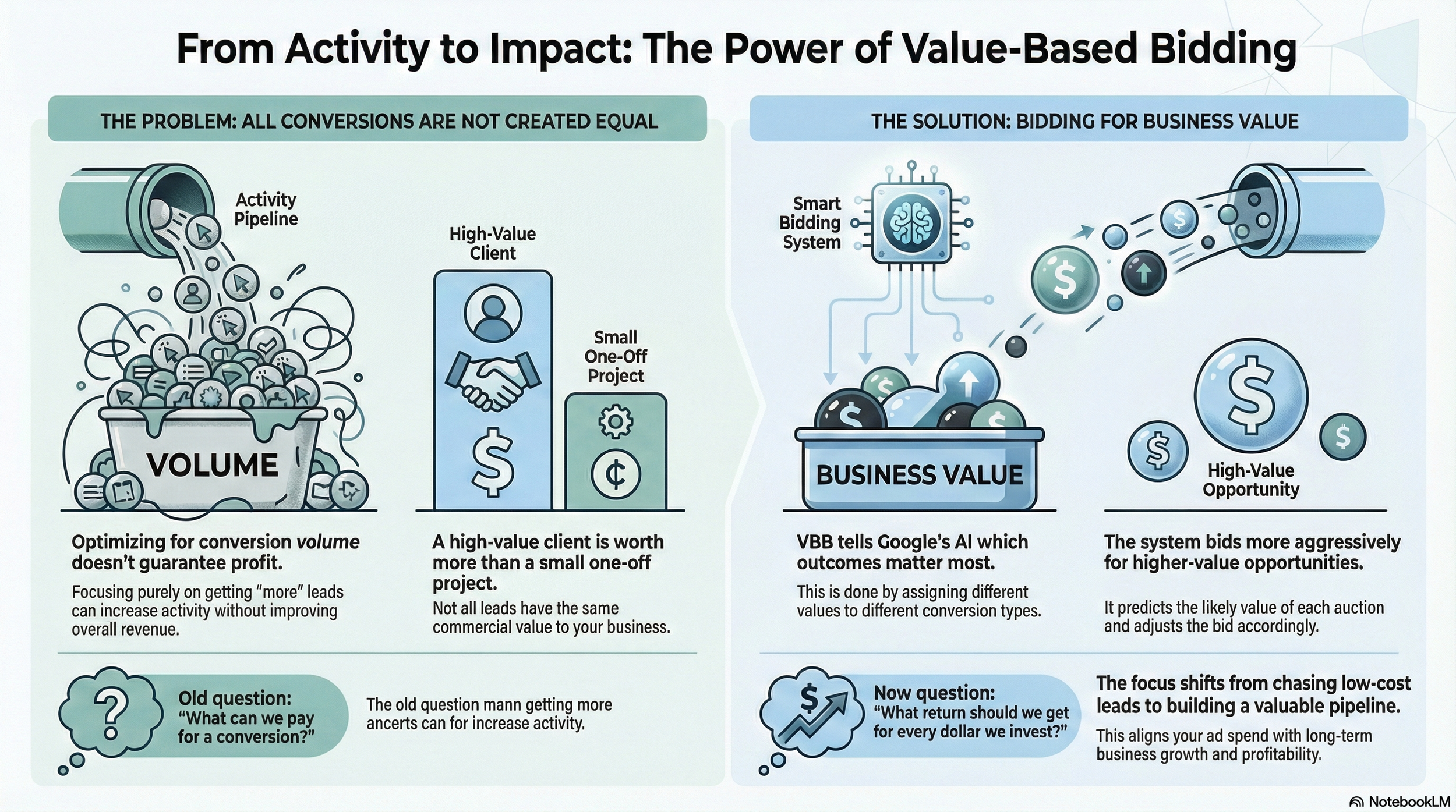
Value-Based Bidding infographic explaining how Google Ads Smart Bidding optimises for conversion value instead of volume, illustrating how higher-value leads and revenue outcomes are prioritised over low-cost, low-impact conversions.
Conversion Tracking: The Foundation of Everything
All of the sophistication we’ve discussed so far; Smart Bidding, value optimisation, intent matching and creative assembly rests on one quiet, essential layer: measurement.
Without reliable conversion tracking, Google’s systems are forced to learn from incomplete or distorted signals. With it, they can make confident, informed decisions that align far more closely with your real business outcomes.
This is why, before scaling or automating, it’s always worth ensuring the foundations are sound.
Data Quality Matters Most
Smart Bidding and value-based strategies don’t simply react to what happened yesterday. They build predictive models based on patterns over time.
That means:
Missing conversions slow down learning
Misattributed conversions skew optimisation
Incomplete data leads to conservative or misguided bidding
Put simply, the system can only optimise towards what it can clearly see.
Global Site Tag
This provides consistent, site-wide measurement of key actions, ensuring that every meaningful interaction can be captured and attributed correctly.
It creates a single, reliable source of truth for:
Page views
Events
Conversions
User journeys across sessions and devices
Enhanced Conversions
As privacy standards evolve, some signals are naturally lost. Enhanced Conversions help recover a portion of this by securely using first-party data (such as hashed email addresses or phone numbers) to improve attribution accuracy.
This allows:
More complete conversion reporting
Better modelling for Smart Bidding
Stronger alignment between ad spend and real outcomes
Consent Mode
Consent Mode ensures your tracking respects user privacy choices while still allowing Google to model and estimate performance where direct signals aren’t available.
It’s not just about compliance. It’s about maintaining learning and optimisation in a world where traditional cookies are no longer guaranteed.
Cross-Device Attribution
Many journeys don’t start and end on the same device, and many high-value conversions happen offline or later in the sales cycle.
By linking:
Google Ads
Google Analytics
CRM and sales systems
you can help Google understand which clicks truly contribute to revenue, not just which ones happen to be last in the chain.
Building a Measurement Layer You Can Trust
Strong tracking doesn’t need to be complex, but it does need to be intentional.
The aim is to ensure that:
The right actions are defined as conversions
The most valuable outcomes are weighted accordingly
Data flows reliably and consistently
Privacy and compliance are respected
Marketing and commercial teams are working from the same picture
When this layer is in place, automation becomes far less intimidating. You know what the system is optimising for, and you can trust the direction it’s moving in.
Optimisation Score: Tool, Not Target
Optimisation Score can be a helpful guide, and a distracting one.
On the surface, it looks simple: a percentage that tells you how “optimised” your account is, along with a list of recommendations to improve it. But like most simple numbers in complex systems, its real value comes from understanding what sits behind it.
Used well, it can highlight genuine opportunities.
Chased blindly, it can pull attention away from what actually matters.
How Google Calculates It
At its core, Optimisation Score is Google’s way of answering one question:
“How closely does this account align with our current best-practice model for performance?”
It looks across areas such as:
Bidding strategies
Budgets and pacing
Ad formats and assets
Keyword coverage and match types
Measurement and conversion setup
Audience and targeting signals
Each recommendation is given a weighted impact, showing how much it would increase your overall score if applied.
A Prioritisation Tool, Not a Performance Guarantee
The score is useful because it:
Surfaces potential improvements quickly
Helps prioritise where effort might have the biggest effect
Makes it easier to spot structural gaps in an account
What it doesn’t do is:
Guarantee improved business outcomes
Understand your margins, capacity, or commercial constraints
Replace strategic judgement
It’s a map, not the destination.
Recommendation Categories
Google groups its suggestions into a few broad themes, helping you understand what type of improvement it’s pointing towards, for example:
Bidding & Budgets – changes to Smart Bidding strategies, targets, or spend pacing
Ads & Assets – adding or improving Responsive Search Ads, sitelinks, callouts, and other extensions
Keywords & Targeting – expanding coverage, refining match types, or addressing gaps
Measurement – improving conversion tracking, enhanced conversions, or consent setup
Account Structure & Settings – alignment with best-practice configurations
Seeing recommendations in these categories makes it easier to step back and ask:
“Is this a tactical tweak, or a strategic decision that needs proper consideration?”
Auto-Apply and the Question of Control
Google allows you to automatically apply certain recommendation types. This can save time, particularly for:
Bidding strategy updates
Asset additions
Measurement enhancements
But automation should always sit within a framework of intent.
When Auto-Apply Makes Sense
It can be helpful when:
The account structure is already sound
Conversion tracking is reliable
Business goals are clearly defined
Safeguards (such as budget limits and negatives) are in place
When to Pause and Review Manually
It’s wise to review manually when recommendations affect:
Budget increases
Expansion into new keyword themes
Changes to match types
Shifts in bidding strategy tied to revenue targets
This is where strategic oversight protects efficiency and alignment.
Using Optimisation Score as a Strategic Signal
Rather than asking:
“How do we get to 100%?”
A more useful question is:
“What is this telling us about where the system sees opportunity or risk?”
High-impact recommendations can point to:
Underutilised automation
Gaps in creative coverage
Incomplete measurement
Budget constraints limiting learning
Structural limitations affecting reach or efficiency
Viewed this way, Optimisation Score becomes part of a diagnostic process, not a scoreboard.
Reassurance for Growing Teams
It’s completely normal for well-run, commercially disciplined accounts to sit below 100%.
That doesn’t mean they’re underperforming. It often means they’re:
Making deliberate choices
Managing risk thoughtfully
Aligning spend with capacity and profitability
Prioritising long-term stability over short-term volume
The aim is not to satisfy a metric.
It’s to build a system that supports sustainable growth.
Forecasting Growth with Performance Planner
One of the hardest parts of managing paid search isn’t optimisation.
It’s planning.
Questions like:
“If we increase budget, what will we actually get back?”
“What happens to CPA if we try to scale?”
“How much headroom is there in this account?”
are commercial questions, not platform ones. Performance Planner is designed to help bridge that gap by moving you from reactive reporting to forward-looking modelling.
Not guesswork.
Not hope.
Informed scenarios.
What Performance Planner Is Really For
At its heart, Performance Planner uses historical data and machine learning to simulate:
How changes to budget might affect conversion volume
How CPA or ROAS may shift as you scale
Where diminishing returns are likely to appear
How seasonality and demand patterns may influence results
It helps answer a calmer, more strategic question:
“What is realistically possible if we invest differently?”
From Spend to Outcomes
Rather than simply saying “spend more”, Performance Planner allows you to explore:
Budget increase scenarios
What happens if we raise spend by 10%, 25%, 50%?Efficiency trade-offs
How much CPA might rise to unlock additional volume?Target adjustments
What happens if we loosen or tighten ROAS or CPA targets?
Understanding the Scale vs Efficiency Balance
Growth is rarely linear.
As you invest more, you often:
Capture lower-hanging fruit first
Then need to pay slightly more to reach incremental demand
Eventually reach a point where returns flatten
Performance Planner helps visualise this curve, so decisions can be made with eyes open rather than in hindsight.
Planning, Not Promising
It’s important to treat forecasts as guidance, not guarantees.
They are:
Directional, not absolute
Based on patterns, not certainties
Most useful when combined with commercial context (margins, capacity, sales cycle, seasonality)
Used properly, they support confident decision-making rather than rigid targets.
How This Supports Strategic Growth Conversations
For business owners and leadership teams, Performance Planner becomes a shared language between:
Marketing
Finance
Sales
Operations
It allows you to discuss:
What level of demand generation the business can support
How marketing investment aligns with growth targets
When scaling makes sense, and when efficiency should be prioritised
How expectations should be set internally
This is where Google Ads moves from being a tactical channel to a strategic growth lever.
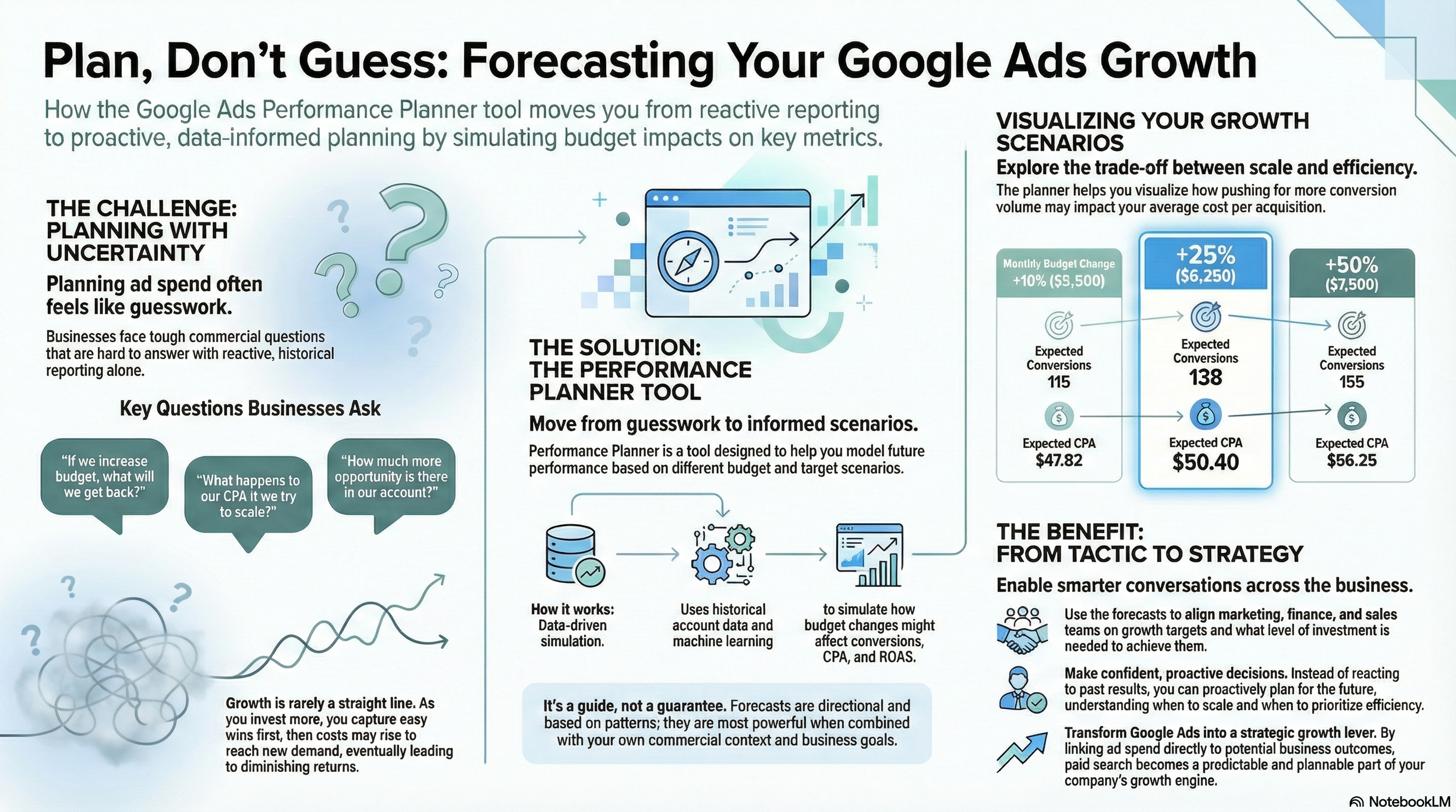
Google Ads Performance Planner infographic showing how budget forecasting works, including projected conversions, CPA, and growth scenarios to support data-driven media planning.
The Align & Scale Way – Turning Google Ads into a Structured Growth System
By this point, it should be clear that modern Google Ads is no longer a collection of isolated tactics.
It’s a system.
A system that connects:
Intent and meaning
Real-time decision-making
Creative relevance
Commercial value
Reliable measurement
Forward-looking planning
When these elements are aligned, Google Ads stops feeling reactive and starts feeling dependable. Predictable. Governable. Supportive of wider business goals.
This is where our ALIGN & SCALE frameworks come in.
They provide the structure around the technology, so growth is intentional rather than accidental.
Mapping to ALIGN – Building Strong Foundations
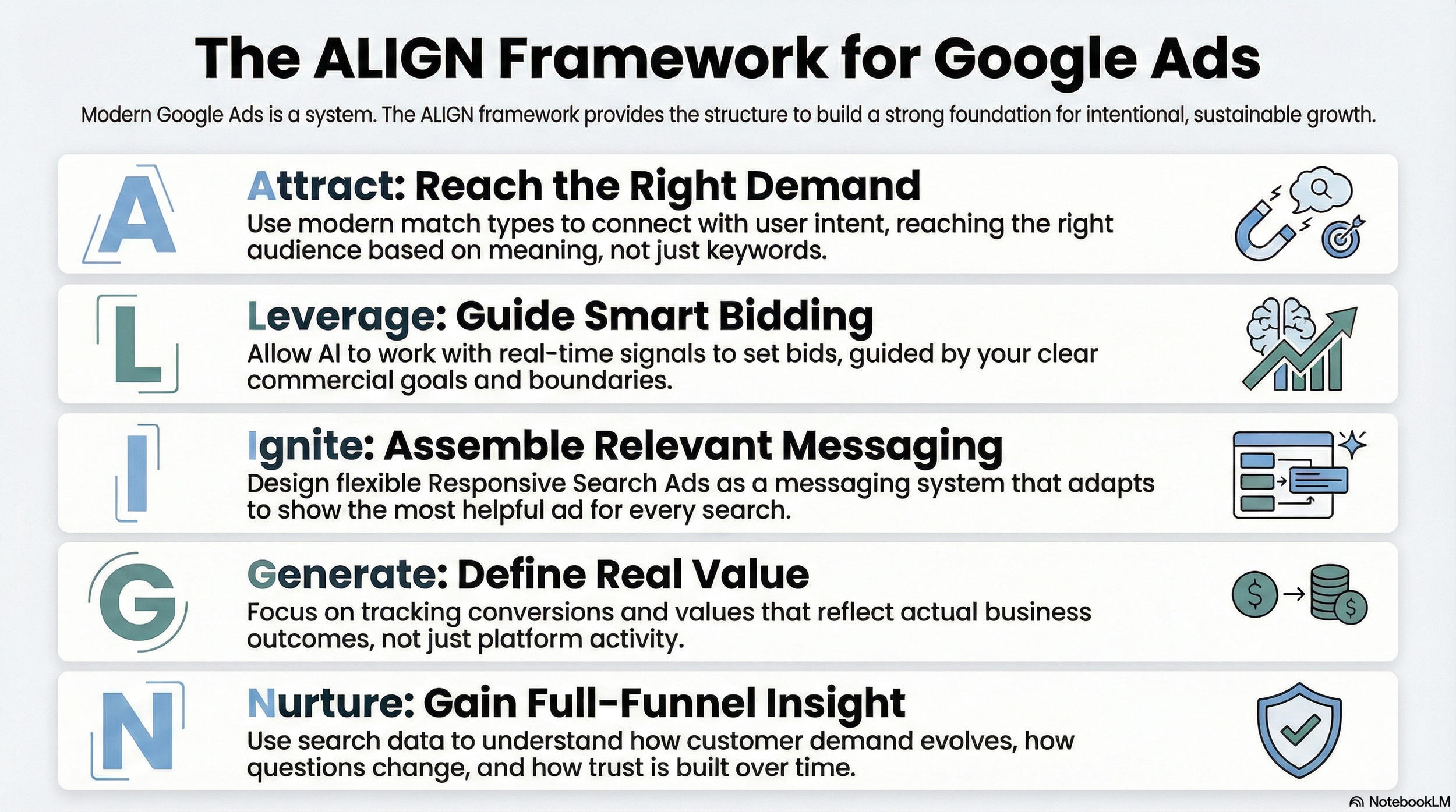
ALIGN framework for Google Ads diagram explaining how Attract, Leverage, Ignite, Generate, and Nurture structure a modern, AI-driven Search strategy from intent matching through Smart Bidding, ad relevance, and conversion measurement.
Attract - Broad Match & Intent
Using broad and phrase match strategically to reach the right demand, guided by meaning and context rather than just keywords.
Leverage - Smart Bidding Signals
Allowing Smart Bidding to work with real-time signals, while setting clear goals and boundaries so the system learns in the right direction.
Ignite - RSA Relevance
Designing Responsive Search Ads as a messaging system, not one-off slogans, so every search sees the most helpful version of your story.
Generate - Conversion Value
Defining conversions and values that reflect real commercial outcomes, not just platform activity.
Nurture - Full-Funnel Insight
Using search data to understand how demand evolves, how questions change, and how trust is built over time.
Mapping to SCALE – Turning Foundations into Momentum
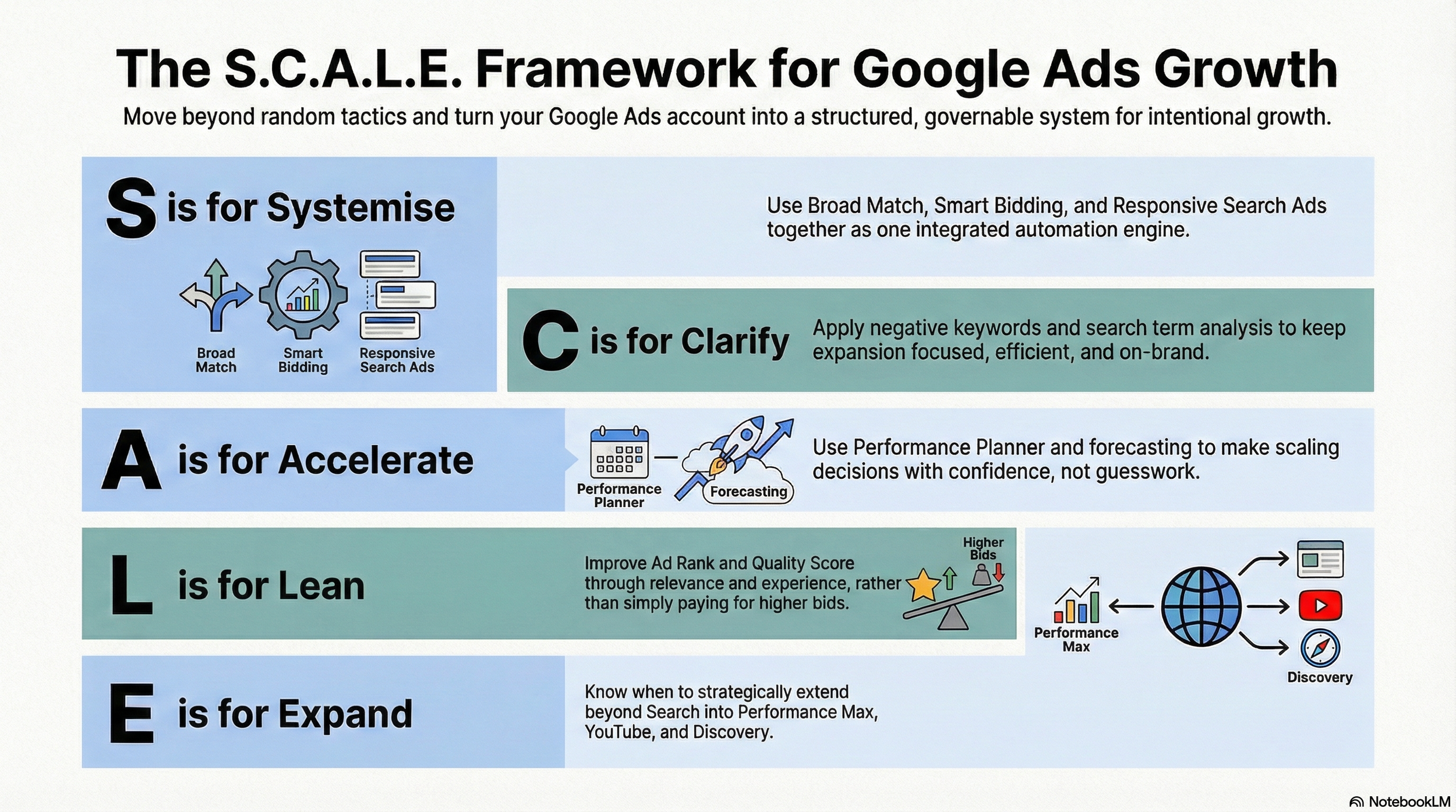
SCALE framework diagram for scaling Google Ads, outlining Systemise, Clarify, Accelerate, Lean, and Expand, and how automation, forecasting, quality optimisation, and channel expansion support structured, sustainable growth.
Systemise - Automation
Using Broad Match, Smart Bidding, and RSAs together as an integrated engine, with structure and governance.
Clarify - Search Intent & Negatives
Applying negative keywords, search term analysis, and account structure to keep expansion focused and efficient.
Accelerate - Performance Planner
Using Performance Planner and forecasting to scale with confidence, not guesswork.
Lean - Quality Score Efficiency
Improving Ad Rank and Quality Score through relevance, experience, and clarity rather than simply higher bids.
Expand - PMax, YouTube, Discovery
Knowing when to extend beyond Search into Performance Max, YouTube, Discovery, and full-funnel activity, with a strategy-led approach.
From Campaigns to Confidence
The aim of this approach isn’t to make Google Ads more complicated.
It’s to make it feel:
Understandable
Governed
Commercially aligned
Supportive of long-term growth
So that instead of asking:
“Why is the platform doing this?”
You’re able to say:
“I understand how this system works, what it’s optimising for, and how it supports our goals.”
That sense of clarity is what allows you to move forward with confidence.
How Align & Scale Supports This in Practice
Whether through:
A structured Google Ads Audit
Ongoing performance and optimisation
Our role is to:
Design the system
Align it with your commercial reality
Guide automation rather than fear it
And support you as the platform evolves
Always calmly.
Always strategically.
Always with growth, not just activity, in mind.